How to Study for a Certification Exam
June 1, 2026
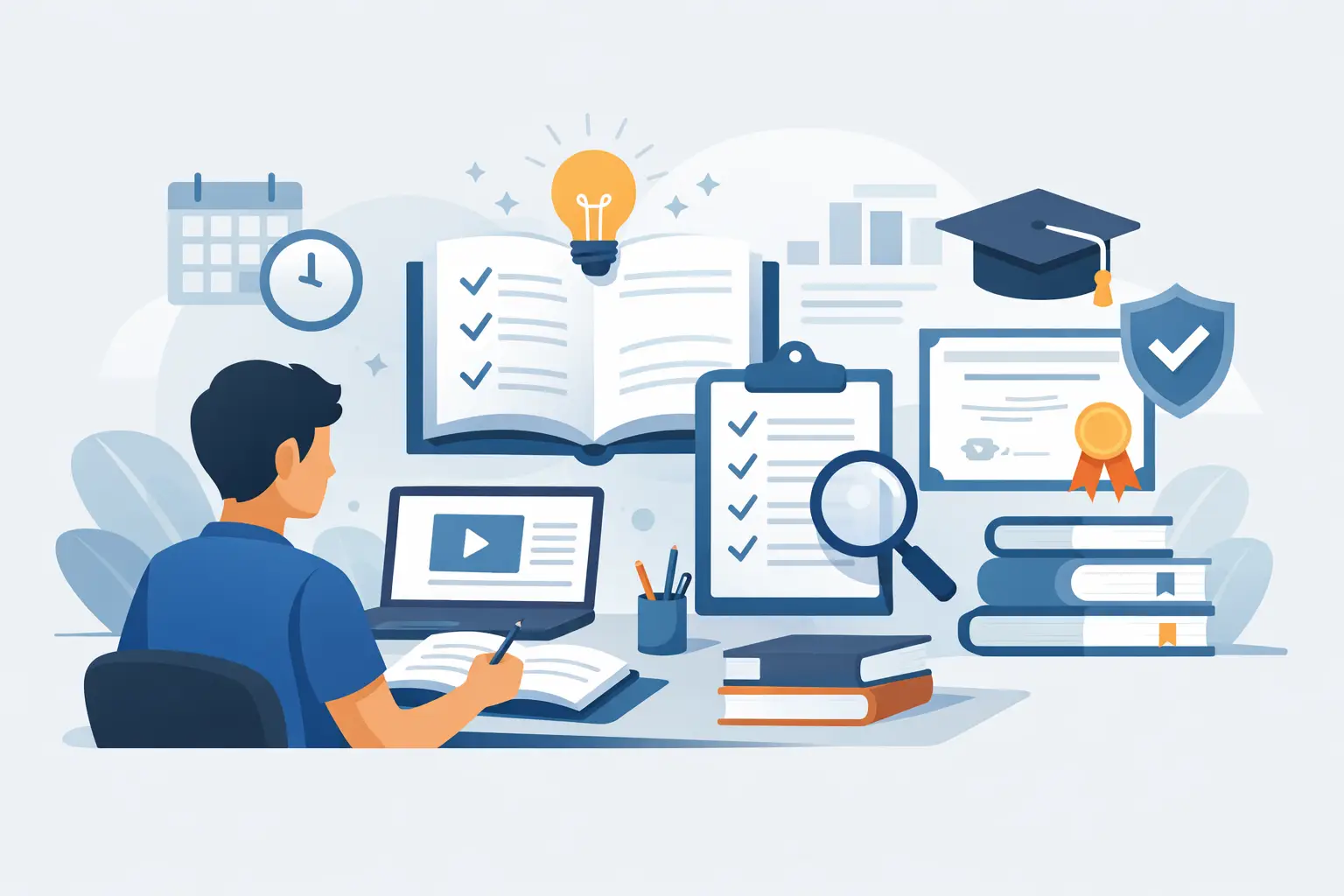
The people who pass certification exams on the first try usually are not the ones who studied the longest. They are the ones who studied with the fewest blind spots. If you want to know how to study for a certification exam, start there: your goal is not to consume more content. Your goal is to close the gap between what the exam expects and how you perform under pressure.
That matters even more in IT and cloud certifications. Exams from AWS, Microsoft Azure, Google Cloud, CompTIA, and similar vendors do not just test recall. They test judgment, pattern recognition, and your ability to make the best choice when two answers look almost right. A weak study plan can leave you feeling productive while your actual exam readiness stays flat.
How to study for a certification exam without wasting time
The fastest path to a passing score starts with one decision: stop treating every topic equally. Certification blueprints are broad, but your weaknesses are specific. A good plan identifies what the exam covers, what you already know, and where your score is most likely to break.
Start by reading the official exam objectives closely. Not casually, and not once. The blueprint tells you what the test writer cares about. It also helps you avoid a common mistake: spending hours on interesting side topics that barely appear on the exam.
Once you have the blueprint, do a diagnostic test early. This feels uncomfortable for a reason. It exposes your weak areas before your confidence has time to inflate. That is useful. If you score poorly on identity and access management but well on networking basics, your next two weeks should not be balanced. They should be targeted.
This is where many candidates fall behind. They study in the order a course presents material instead of the order their performance demands. Those are not the same thing.
Build a study system, not a study mood
Motivation is unreliable. Systems scale.
A strong certification study system has three parts: time blocks, topic priorities, and review loops. Time blocks keep your progress moving even on busy weeks. Topic priorities make sure your energy goes to the domains that matter most. Review loops stop you from forgetting what you covered five days ago.
For most working professionals, five to six focused sessions per week is more effective than one marathon weekend session. Ninety minutes of active work beats four distracted hours every time. If your schedule is heavy, even 45-minute sessions can work, but only if they are deliberate.
Your weekly rhythm should include new learning, practice questions, and review. If all you do is watch videos or read documentation, you can mistake familiarity for competence. Recognition is not the same as recall, and neither is the same as exam performance.
A simple structure works well. Early in the week, learn or refresh a domain. Midweek, answer exam-style questions on that domain. Later, review every wrong answer and rewrite the reason you missed it. At the end of the week, take a mixed set to test retention across topics.
That cycle creates pressure in the right places. It also helps you see whether your issue is knowledge, question interpretation, or time management.
Use active recall and realistic practice
If you are wondering how to study for a certification exam efficiently, this is the leverage point: active recall plus realistic simulation.
Active recall means forcing your brain to produce the answer before you see it. That can happen through flashcards, whiteboard summaries, quick self-quizzing, or scenario questions. It feels harder than rereading because it is harder. That is exactly why it works.
Realistic practice matters because certification exams are not neutral reading exercises. They have pacing, distractors, long scenario wording, and answer choices designed to test precision. Static notes cannot train that. Generic question banks often cannot either, especially if the questions are too easy, outdated, or disconnected from the actual exam style.
A simulator-based approach is stronger because it trains both knowledge and execution. When practice happens in an exam-like environment, you learn how to manage time, recover from difficult questions, and stay accurate when your confidence dips. That is a different skill from simply knowing the material.
Used well, practice exams are not just score checks. They are feedback engines. They show where you hesitate, where you rush, and which domains keep pulling your score down. That is why analytics matter. A percentage alone does not tell you enough. You need to know the pattern behind the percentage.
Review wrong answers like an engineer
Most candidates review incorrectly. They check the right answer, nod, and move on. That creates the illusion of improvement without the actual gain.
A better approach is to classify each mistake. Did you miss the concept entirely? Did you misread a keyword such as most cost-effective, highest availability, or least operational overhead? Did you narrow it to two choices and pick the weaker one? Those are different problems, and they need different fixes.
When you review, write a short note in your own words about why the correct answer is right and why your answer is wrong. Keep it tight. One or two sentences is enough. The point is to build a memory trace you can reuse later.
Pay extra attention to repeat misses. If the same topic keeps appearing in your wrong answers, that is not random. It is a warning. Go back to the source material, relearn the concept, and test it again within 24 to 48 hours.
This is also where AI-assisted prep can be useful if it helps explain patterns in your mistakes and recommends what to study next. The key is using support that sharpens your decision-making instead of burying you in more content.
Manage the trade-off between breadth and depth
Every certification candidate faces the same tension: the exam covers a lot, but your time is limited.
The right answer is rarely to study everything with equal depth. Some topics need conceptual clarity. Others need memorization. Others need repeated scenario practice until your choices become faster and cleaner.
For example, a cloud certification may require broad awareness across compute, storage, networking, security, pricing, and operations. But if the exam is role-based, some domains will carry more weight and more scenario complexity. That is where your deeper effort should go.
There is an it depends factor here. If you are already hands-on with Azure administration, your study plan can lean harder into weak domains like governance or identity. If you are newer to cloud, you may need more foundation work before heavy practice testing makes sense. Realistic prep should adapt to your starting point, not force every learner into the same sequence.
Don’t confuse confidence with readiness
Some people delay the exam because they never feel fully ready. Others book it too early because one good practice score makes them overconfident. Both mistakes are expensive.
Readiness is not a feeling. It is a pattern.
You are getting close when your scores are consistently above your target range, not just once. You are getting close when your weak domains are shrinking instead of rotating randomly. You are getting close when you can explain why an answer is correct without guessing.
A useful benchmark is consistency across multiple mixed practice exams under realistic conditions. If your performance holds up across different sets, with timing on, and your review notes are getting shorter because you are making fewer conceptual mistakes, that is a strong signal.
If your scores swing wildly, do not ignore that. It usually means your knowledge is fragmented. You may know topics in isolation but struggle to apply them when the exam mixes domains together.
Protect your performance in the final week
The last seven days should not feel like panic. They should feel like sharpening.
At that stage, stop chasing every edge case. Focus on weak domains, high-frequency concepts, and timed practice. Review your error log. Revisit the concepts you have missed more than once. Keep sessions focused and avoid late-night cramming that wrecks retention.
The day before the exam, reduce the load. A light review is fine. A six-hour stress session is not. Fatigue hurts judgment, and judgment is what these exams test.
On exam day, pace matters. If a question is taking too long, make your best choice, mark it, and move on if the format allows. One stubborn question should not steal time from five easier ones. Read qualifiers carefully. Words like best, first, most secure, lowest cost, and least administrative effort often decide the answer.
If you want a stronger preparation workflow, CertSim is built for exactly this kind of exam readiness - realistic simulation, targeted practice, analytics, and structured study support that helps serious candidates improve where it counts.
Certification prep works best when it stops being vague. Build the plan, pressure-test it, and let your weak spots show early. That is how progress becomes measurable, and how passing stops feeling like luck.
Ready to practice?
Take realistic practice exams with AI explanations and track your readiness.
Start free