Practice Exams vs Study Guides
June 23, 2026
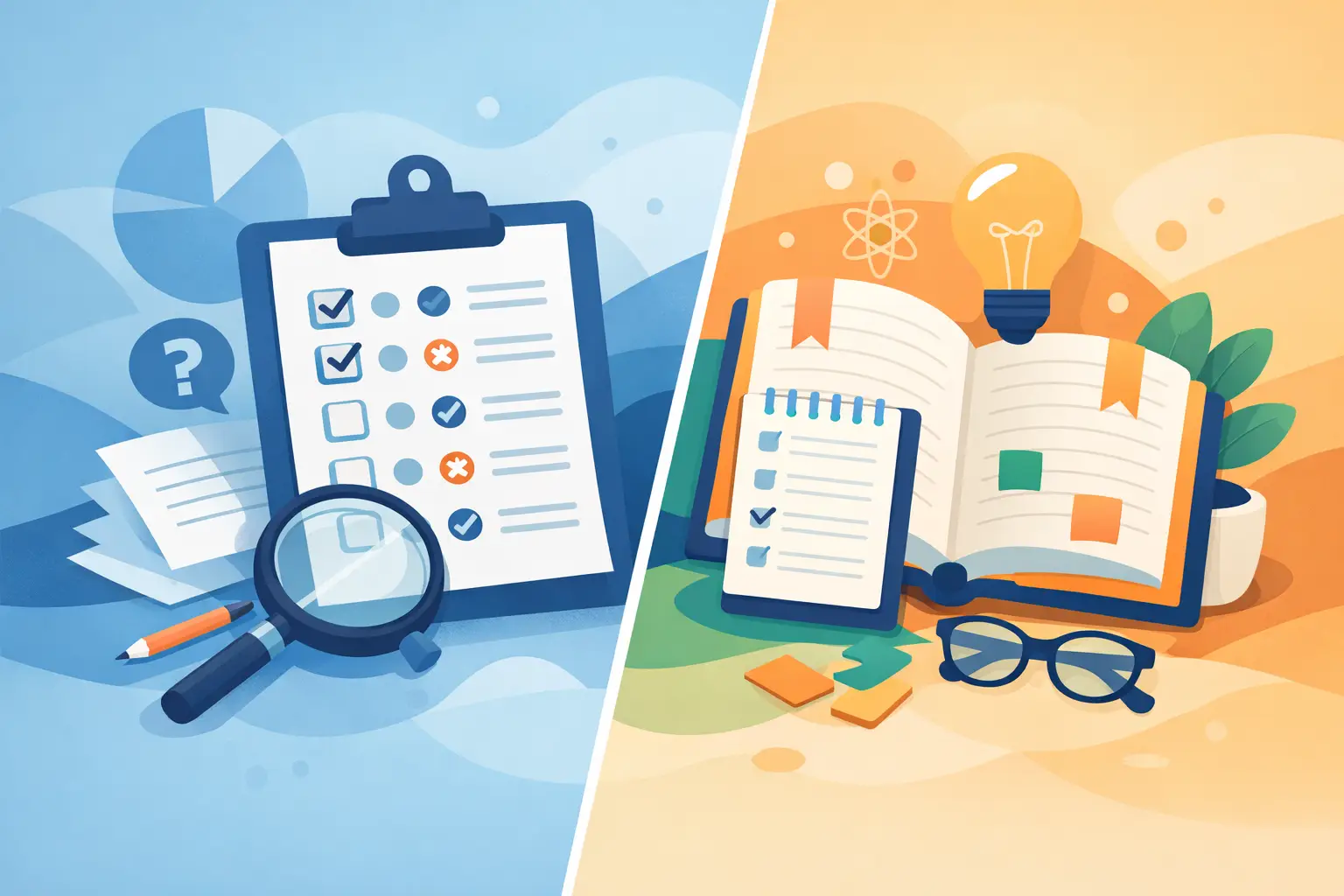
If your exam date is close and your prep still feels scattered, the question is not whether you should study harder. It is whether you are using the right tool. In the debate around practice exams vs study guides, most certification candidates do not fail because they lacked information. They fail because they misjudged readiness.
That matters even more in IT certification. AWS, Azure, Google Cloud, CompTIA, and similar exams are expensive, timed, and built to test judgment under pressure. You are not just recalling facts. You are interpreting scenarios, ruling out distractors, and making decisions fast. A study method that feels productive is not always the one that gets you over the line.
Practice exams vs study guides, what each really does
Study guides are built to teach. They organize concepts, explain services, define terms, and give you the foundation to understand what the exam is asking. For a learner who is new to cloud, identity, networking, security, or architecture, that structure matters. Without it, practice questions can feel random and frustrating.
Practice exams are built to measure and pressure test. They show whether you can apply knowledge in exam conditions. They expose weak areas quickly, especially when the question format mirrors the real certification. Instead of asking, "Do I recognize this topic?" they ask, "Can I answer correctly when the clock is running and two answer choices look almost right?"
That difference is why so many candidates overvalue study guides. Reading gives a sense of progress. You move through chapters, highlight key ideas, and feel more informed. But information is not the same as exam performance. If your goal is passing on the first attempt, you need more than coverage. You need proof.
When study guides are the better choice
A study guide is often the right starting point when the certification domain is still unfamiliar. If you are moving into cloud from help desk, or switching from systems administration into DevOps, you need a map before you start testing yourself. Good study guides create that map. They help you understand service categories, core terminology, and how major topics connect.
They are also useful when your exam blueprint includes broad conceptual coverage. Some exams test vocabulary, architecture principles, compliance ideas, and best practices across a wide range of domains. In that case, a guide helps you avoid blind spots.
But there is a trade off. Study guides tend to be linear, while real exam performance is not. You may read one chapter at a time and feel comfortable in sequence, yet still struggle when mixed questions force rapid context switching. That is where many candidates hit a wall. They know the content, but they have not trained the skill of taking the exam.
Another limit is passivity. Reading and note taking can support learning, but they do not always reveal what you actually cannot do yet. A concept may look familiar on the page and still collapse when turned into a scenario based question.
When practice exams are the better choice
Practice exams become more valuable as your test date approaches. Once you have baseline knowledge, the highest return often comes from simulation. You are no longer trying to learn every detail from scratch. You are trying to identify gaps, improve decision speed, and build consistency.
This is especially true for professional level certifications, where the hard part is often not remembering a definition. It is choosing the best answer among several plausible ones. Realistic practice forces you to think the way the exam expects you to think.
A strong practice exam also gives you feedback that a study guide cannot. You can see patterns in your misses. Maybe you keep rushing through networking questions. Maybe you understand IAM concepts but get tripped up by wording. Maybe your score drops sharply after 40 minutes because endurance is part of the problem. Those insights are operational. You can act on them.
That is why serious candidates usually shift toward practice focused preparation in the final stretch. At that point, exam readiness is less about collecting more material and more about proving control under conditions that resemble the real test.
The real problem, using one without the other
The smartest answer to practice exams vs study guides is not that one is universally better. It is that each solves a different problem, and using only one creates avoidable risk.
If you rely only on study guides, you may understand the domain but still freeze on exam day. Your pacing may be off. Your confidence may be inflated. The first time you face realistic time pressure should not be in the testing center.
If you rely only on practice exams too early, you may end up memorizing question patterns without truly understanding the content. Your scores can improve for the wrong reason. That feels good until the actual exam presents the same concept in a different way.
The better strategy is to sequence them correctly. Build comprehension first, then validate it aggressively.
How to use practice exams and study guides together
Start with the exam blueprint, not with random content. Break the domains into major sections and use a study guide to build your base. Focus on understanding the why behind core services, architectures, and operational choices. For cloud certifications, that means more than memorizing product names. You need to know when a service is appropriate, what trade offs it introduces, and how it fits a scenario.
Once you have basic coverage, begin using practice exams early enough that they can shape your study plan. Do not wait until the final weekend. Your first few attempts are diagnostic. They tell you where to go back and study deeper.
From there, alternate deliberately. Read to close a gap. Test to confirm it is closed. That cycle is far more efficient than reading a full book and hoping retention holds. It also keeps motivation high, because progress becomes measurable.
As your exam gets closer, increase the weight of simulation. That means full length sessions, timed attempts, and review of why each wrong answer was wrong. This phase is where many candidates gain the edge they were missing. They stop preparing in theory and start performing in practice.
A modern prep platform can make that process much tighter. Instead of static review alone, you can use realistic simulations, analytics, and AI guided recommendations to target the topics and habits that are actually holding your score back. That is where platforms like CertSim fit naturally into a serious prep plan. The point is not more content. The point is better feedback and more accurate readiness.
Which one helps more with exam anxiety
For most certification candidates, practice exams are more effective against anxiety than study guides. Anxiety often comes from uncertainty, not from lack of effort. You are worried because you do not know how you will perform under pressure.
Study guides can reduce anxiety at the beginning by making the material feel organized. But they rarely answer the hardest question, which is, "Am I ready right now?" Practice exams answer that more honestly. They also make the testing environment feel familiar, which lowers the shock of exam day.
That said, anxiety can get worse if you use practice exams badly. Taking full tests repeatedly without reviewing your mistakes can become discouraging. The goal is not to chase random scores. The goal is to learn from the data, improve weak domains, and see evidence that your performance is stabilizing.
A simple decision rule for certification prep
If you are early in your journey, use study guides to build understanding. If you are within a few weeks of your exam, practice exams should carry more weight. If your issue is confusion, read more. If your issue is uncertainty about performance, simulate more.
For most IT professionals, the best preparation path is not fifty percent study guide and fifty percent practice exam at all times. It changes by stage. Early prep leans toward learning. Final prep leans toward execution.
That shift matters because certifications reward applied judgment, not just exposure. The closer your preparation gets to the real testing experience, the more trustworthy your confidence becomes.
A good study guide can teach you the material. A good practice exam can tell you whether you are ready to bet an exam fee on that knowledge. When the goal is career progress, that is the difference that counts.
The best prep method is the one that tells you the truth early enough to improve, and gives you enough repetition to walk into the exam already familiar with pressure.
Ready to practice?
Take realistic practice exams with AI explanations and track your readiness.
Start free