How to Reduce Certification Exam Anxiety Fast
August 12, 2026
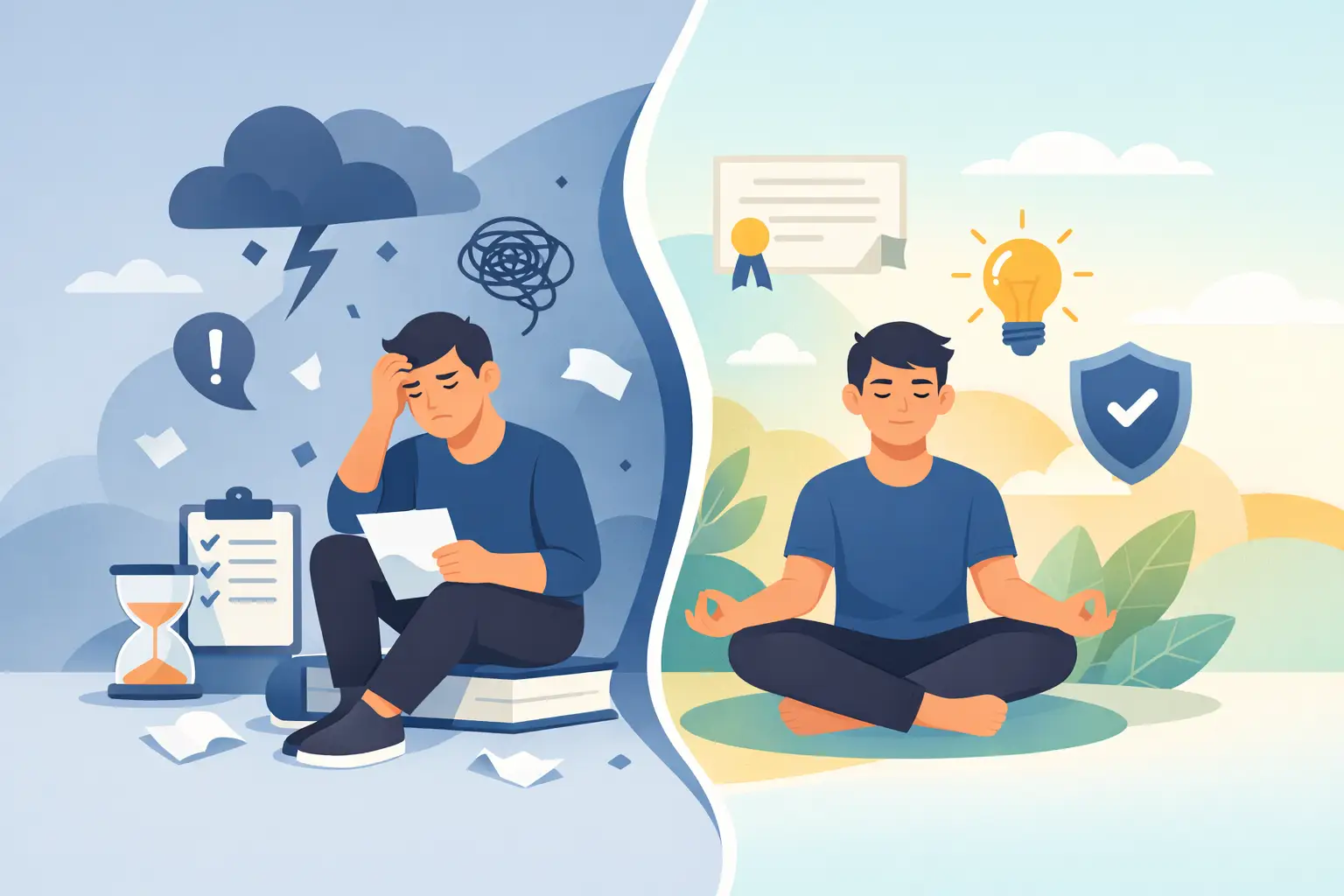
Your AWS, Azure, or Google Cloud exam can be expensive, time limited, and connected to your next career move. That pressure can make even well prepared candidates second guess familiar questions. To reduce certification exam anxiety fast, you need more than positive thinking. You need evidence that you can perform under conditions that resemble the real exam.
Exam anxiety is not always a sign that you are unprepared. Often, it is a sign that your preparation has been too passive. Reading documentation, watching training videos, and highlighting notes can build knowledge, but they do not always prove that you can retrieve that knowledge quickly when a timer is running. The goal is to turn uncertainty into measurable readiness.
Why certification exam anxiety gets so intense
Professional certification exams create a specific kind of pressure. The questions are often scenario based, the language can be deliberately precise, and several answers may look plausible. You are not simply recalling a definition. You are choosing the best technical decision with limited time and no one to ask for confirmation.
That uncertainty creates a mental loop. You wonder whether you studied the right domains, whether your score on practice questions means anything, and whether a difficult item means you are failing. Once that loop starts, attention moves away from the question in front of you and toward the consequences of getting it wrong.
The fastest way to interrupt that pattern is to make the test environment familiar. Familiarity lowers the threat response because your brain has already practiced the sequence: read the scenario, identify the requirement, eliminate weak choices, select the best answer, and move on.
Reduce certification exam anxiety fast with simulation
Realistic timed practice is the highest value move when anxiety comes from not knowing what exam day will feel like. Take a full length or substantial timed practice session in a quiet setting. Use the same time of day as your scheduled exam if possible. Put your phone away, avoid pausing for answers, and complete the session in one sitting.
Your first timed score is not a verdict on your ability. It is a diagnostic. It tells you where pressure affects your decision making, which domains need more work, and whether pacing is a real issue. A lower score can feel uncomfortable, but vague fear is harder to improve than a clear performance gap.
After the simulation, do not rush into another attempt. Review each missed question and each correct answer you guessed. Ask what signal in the scenario pointed to the right answer. Was the question testing security, cost optimization, availability, identity, networking, or operational responsibility? This turns a mistake into a pattern you can recognize later.
A platform such as CertSim can help make this process more targeted by combining realistic questions with performance analytics and an AI assisted study plan. The value is not just getting more questions. It is seeing where your knowledge breaks down, then practicing the exact decision patterns that need reinforcement.
Replace broad studying with an exam readiness plan
Anxiety grows when your study plan is a long, undefined task list. “Review Azure” or “study IAM” gives you no finish line. Build a short plan based on your remaining time and your weakest exam domains.
If your exam is more than two weeks away, alternate between focused content review and timed question sets. Use the review session to close one defined gap, then use questions to test whether you can apply it. For example, after reviewing AWS storage options, practice scenarios that ask you to balance durability, access frequency, cost, and encryption requirements.
If your exam is within a week, avoid trying to relearn the entire blueprint. Prioritize high frequency weak areas, common confusion points, and timed performance. At this stage, your job is to improve recall and judgment, not create a perfect set of notes.
Track progress in three categories: concepts you know immediately, concepts you can solve with careful reasoning, and concepts that still cause confusion. The middle category deserves most of your time. These are the topics closest to becoming reliable exam points.
Use a pressure proof question routine
You need a repeatable process for difficult questions. Without one, anxiety encourages two costly habits: reading too fast or rereading the same paragraph until time disappears.
Start by identifying what the question is actually asking for. Look for words such as lowest cost, least operational effort, most secure, highly available, or minimal latency. These words define the decision criteria. A technically valid answer may still be wrong if it does not satisfy the stated priority.
Next, eliminate answers that clearly violate a requirement. If the scenario requires managed services and minimal administration, options that depend on maintaining infrastructure are usually weaker. If the requirement is immediate recovery, an answer built around a long manual process is unlikely to be best.
Then make your selection and move forward. Mark questions only when you have a specific reason to revisit them, such as a calculation you want to check or two answers that remain close. Do not mark every uncertain question. Excessive flagging creates a large end of exam workload and can make you feel behind even when your pacing is fine.
Train your pacing before exam day
Time pressure is one of the most common sources of certification anxiety, and it is trainable. Divide the total exam time by the number of questions to find your average time per item. You do not need to spend exactly that amount on every question. Easy questions should take less time, leaving room for scenario heavy items.
During practice, check your pace at a few planned points, such as one quarter, halfway, and three quarters through the exam. Avoid checking the timer after every question. Constant monitoring increases stress and disrupts concentration.
If you consistently run out of time, the answer is usually not to read faster. Improve how you identify requirements and eliminate options. Technical exams reward precise reasoning, not frantic speed. Timed simulations reveal whether your issue is knowledge, question interpretation, or decision delay.
Control the final 24 hours
The day before an exam is not the time for a marathon study session. Cramming late into the night can leave you tired and more likely to interpret normal uncertainty as panic. Instead, complete a short, focused review of your notes, recurring mistakes, and key service comparisons.
Prepare the logistics early. Confirm the test location or online check in requirements, identification, start time, internet setup if relevant, and any rules for breaks. Small logistical unknowns consume mental energy that should be reserved for the exam.
Protect sleep, hydration, and a normal meal. This is not generic wellness advice. Working memory, attention, and judgment all decline when you are exhausted or distracted by physical discomfort. You are preparing for a performance event.
On exam morning, avoid searching forums for last minute predictions or comparing your readiness to someone else’s. Review only a short confidence list: your question routine, your pacing checkpoints, and a few facts you repeatedly mix up. Then stop studying.
When anxiety still shows up during the exam
You do not need to eliminate every nervous feeling to perform well. A small amount of activation can sharpen focus. The problem begins when a difficult question convinces you that the entire exam is going badly.
When that happens, pause for one slow breath, return to the stated requirement, and use your question routine. One hard item is not evidence of failure. Certification exams are designed to include questions that force careful judgment. Your job is not to feel certain about every answer. Your job is to make the best decision with the evidence available and protect your time for the next question.
Confidence comes from repetition with feedback, not from waiting until fear disappears. Practice under realistic conditions, review with purpose, and let your data define readiness. When exam day arrives, you will be executing a routine you have already proven you can handle.
Ready to practice?
Take realistic practice exams with AI explanations and track your readiness.
Start free