Timed Simulations Versus Untimed Quizzes
August 8, 2026
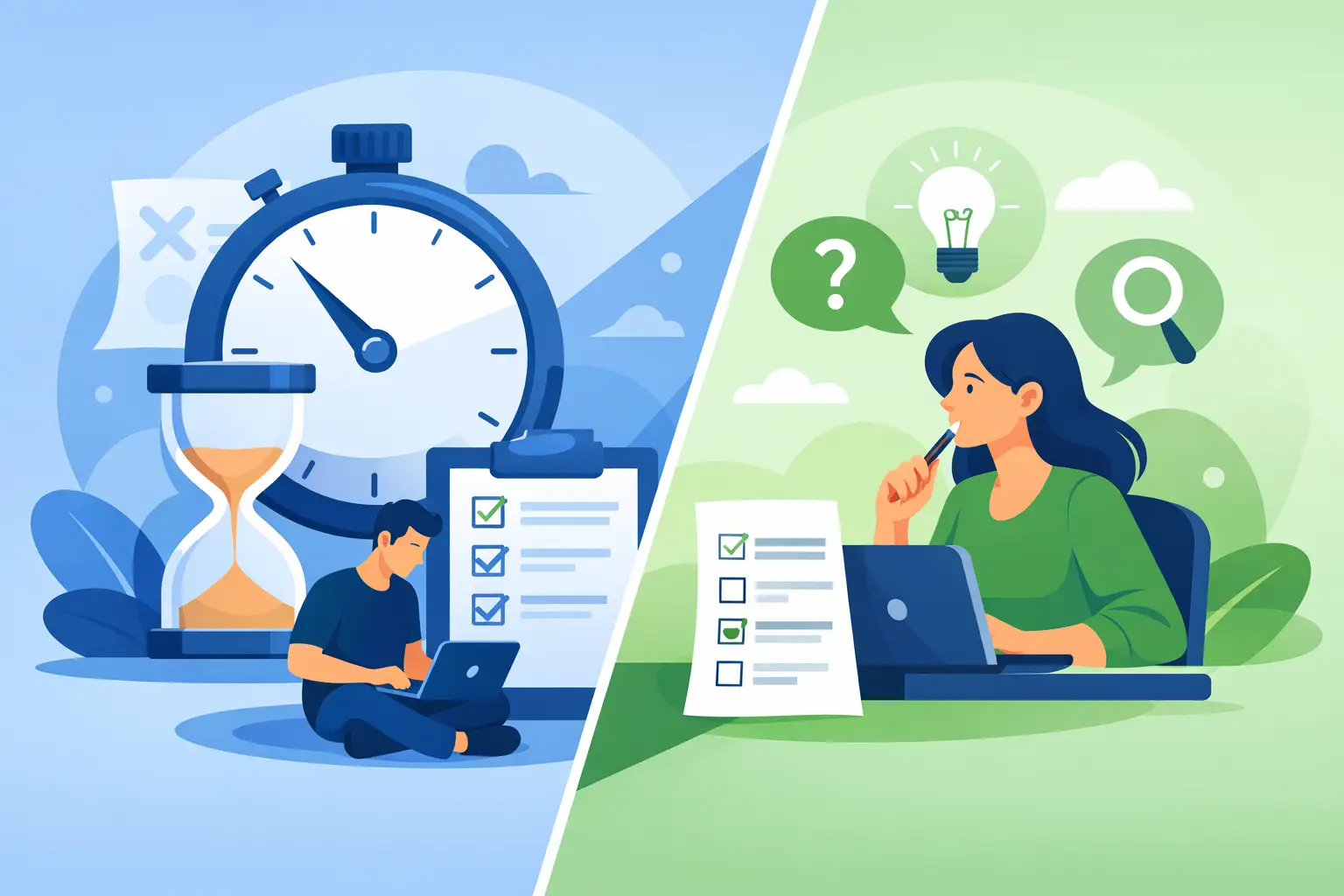
A cloud certification exam can turn familiar material into a difficult decision when the clock is running. You may understand IAM policies, Azure networking, or Google Cloud storage in isolation, yet lose points by rereading scenarios, second guessing answers, or spending too long on one complex question. Timed simulations versus untimed quizzes are not competing study methods. They develop different parts of exam readiness.
For serious certification candidates, the right question is not which mode is better. It is which mode will expose the next barrier between your current knowledge and a passing score.
What Untimed Quizzes Actually Measure
Untimed quizzes are designed for learning accuracy before speed. They give you space to read every detail, trace the logic of a scenario, compare answer options, and identify the exact concept behind a mistake. This is where you build the decision making foundation required for AWS, Microsoft Azure, Google Cloud, and other technical certifications.
When an answer is wrong in an untimed quiz, do not treat it as a score problem. Treat it as evidence. Perhaps you selected a technically valid service that did not meet the cost requirement. Perhaps you missed a security constraint in the question. Perhaps you know what a load balancer does but cannot yet distinguish which option fits a specific architecture.
That distinction matters. Certification exams rarely reward memorizing isolated facts. They test whether you can interpret requirements and choose the best solution within the limits given. Untimed practice lets you slow down enough to see the reasoning pattern behind each question.
This mode is especially valuable early in a study plan, after a weak domain appears in your analytics, or when you are learning a new certification track. If you repeatedly miss questions about VPC connectivity, identity management, containers, or disaster recovery, adding a timer will not fix the gap. Focused review will.
What Timed Simulations Measure
Timed simulations test your ability to perform under exam conditions. Knowledge still matters, but pace, focus, and recovery from difficult questions become part of the score.
A realistic timed session shows whether your current process can survive the pressure of the real exam. Can you read a long scenario without overlooking a requirement? Can you eliminate weak answers efficiently? Can you make a reasonable choice, flag a question mentally, and keep moving when certainty is not available?
These are real test taking skills. Many candidates leave a simulation thinking they knew the content, yet their result says otherwise. Often, the issue is not lack of knowledge. It is poor time allocation. Spending four minutes trying to reach perfect confidence on one question can cost several easier questions later in the exam.
Timed simulations also make anxiety visible. If your accuracy falls sharply only when the countdown begins, that is useful information. You do not need more random questions. You need repeated, controlled exposure to realistic timing until the testing environment feels familiar rather than threatening.
Timed Simulations Versus Untimed Quizzes at Each Stage
Your practice mode should change as your readiness changes. At the beginning, untimed quizzes should do most of the work. Their purpose is to build accurate thinking, clarify terminology, and reveal weak objectives before you cement bad habits.
As your accuracy improves, introduce short timed sets. A set of 10 to 20 questions is enough to practice pace without turning every study session into a high pressure event. Review every missed question after the timer ends, including answers you guessed correctly. A correct guess is not reliable knowledge.
In the final phase, full timed simulations should become more frequent. This is the closest practice for test day because it combines content recall, scenario analysis, endurance, and time management. Use the results to judge readiness across domains, not just by your overall percentage.
A strong candidate may score well overall while carrying a serious weakness in one exam objective. If cloud security questions are consistently below your target, a good overall simulation score can create false confidence. Return to untimed practice for that domain, rebuild understanding, then test it again under time pressure.
The Best Workflow Is a Cycle, Not a Choice
The most effective preparation loop moves between learning mode and performance mode. First, use untimed quizzes to understand why each answer is correct or incorrect. Then use timed question sets to check whether that knowledge remains available at exam pace. Finally, use a full simulation to measure whether your combined skills hold up over a longer session.
After each simulation, review the data with discipline. Look for patterns such as repeated mistakes in a service category, low accuracy on scenario questions, or a drop in performance near the end of the session. Each pattern points to a different action.
If a topic is weak from the first question onward, study the domain and use untimed quizzes. If your first half is strong but your last section collapses, practice longer timed sessions and improve pacing. If you are accurate but slow, work on answer elimination and recognizing common question structures. The solution should match the problem.
This is where analytics are more useful than a simple score. A score tells you where you landed. Performance patterns show you what to do next.
How to Build Better Timing Without Rushing
The goal of timed practice is not to answer every question as fast as possible. It is to control your pace so one difficult item does not control your entire exam.
Start by calculating a rough time budget based on the number of questions and the exam duration. Then practice a simple decision rule: if you can narrow the choices but still need excessive time to decide, make your best selection and move forward. You can revisit the concept during review, when the timer is no longer consuming your score.
Avoid checking the clock after every question. That habit can create more pressure and interrupt your concentration. Instead, check at planned intervals, such as after completing a section of questions. This gives you a clear signal about whether your pace needs adjustment.
You should also practice reading for constraints. Certification questions often include clues about cost, scalability, availability, operational effort, compliance, or migration speed. The best answer is usually the option that satisfies the stated constraints with the least unnecessary complexity. Training yourself to spot those signals quickly improves both speed and accuracy.
When Untimed Practice Becomes a Problem
Untimed quizzes can become too comfortable if you stay in them too long. If you regularly spend several minutes researching every option before answering, your score may reflect access to study materials rather than exam readiness. The real exam will not pause while you verify a service limit or revisit a documentation page.
A warning sign is high untimed accuracy paired with disappointing timed results. Another is avoiding full simulations because the result feels uncertain. That discomfort is exactly why timed practice belongs in your plan. It turns uncertainty into a measurable performance target.
The goal is not to eliminate every difficult question before test day. It is to enter the exam knowing you can manage difficult questions without losing control of the session.
Make Every Practice Session Earn Its Place
Use untimed quizzes when you need to learn, diagnose, and correct. Use timed simulations when you need to prove that your knowledge can perform under realistic conditions. Both are essential, but they should not receive equal time every week.
CertSim helps candidates combine realistic exam style practice with targeted analytics and AI assisted study guidance, so the next session can address a real weakness rather than repeat familiar material. As your exam date approaches, let your performance data decide when to slow down and learn, and when to start the clock and execute.
Ready to practice?
Take realistic practice exams with AI explanations and track your readiness.
Start free